The operational context created before a data center goes live has become too valuable to lose. MCIM CEO Mike Parks discusses why preserving the digital thread from design through operations is becoming a reliability imperative.
Data centers generate some of their most valuable operational intelligence before they ever go live. Design, construction, testing and commissioning create a detailed record of what was built, how it was intended to operate, how it actually performed under test, and what was addressed if it performed poorly.
That information was paid for, but the context is not making its way to operations on day one. Much of it remains fragmented across BIM models, drawings, commissioning reports, BMS and EPMS platforms, spreadsheets, and individual expertise. When the facility transitions to operations, teams can be left piecing that history back together. That’s why the digital thread needs to start before ready for service, so operators can ensure that the knowledge created before go-live follows the facility into operations.
Commissioning Creates a Baseline Worth Preserving
One of the most valuable parts of that digital thread is created during commissioning. It may be the best opportunity an operator has to establish a trustworthy baseline for the facility, as systems are deliberately exercised across normal and abnormal conditions, dependencies are tested, deficiencies are uncovered, and expected behavior is validated. Once the facility is live, recreating that same breadth of controlled observation becomes much harder.
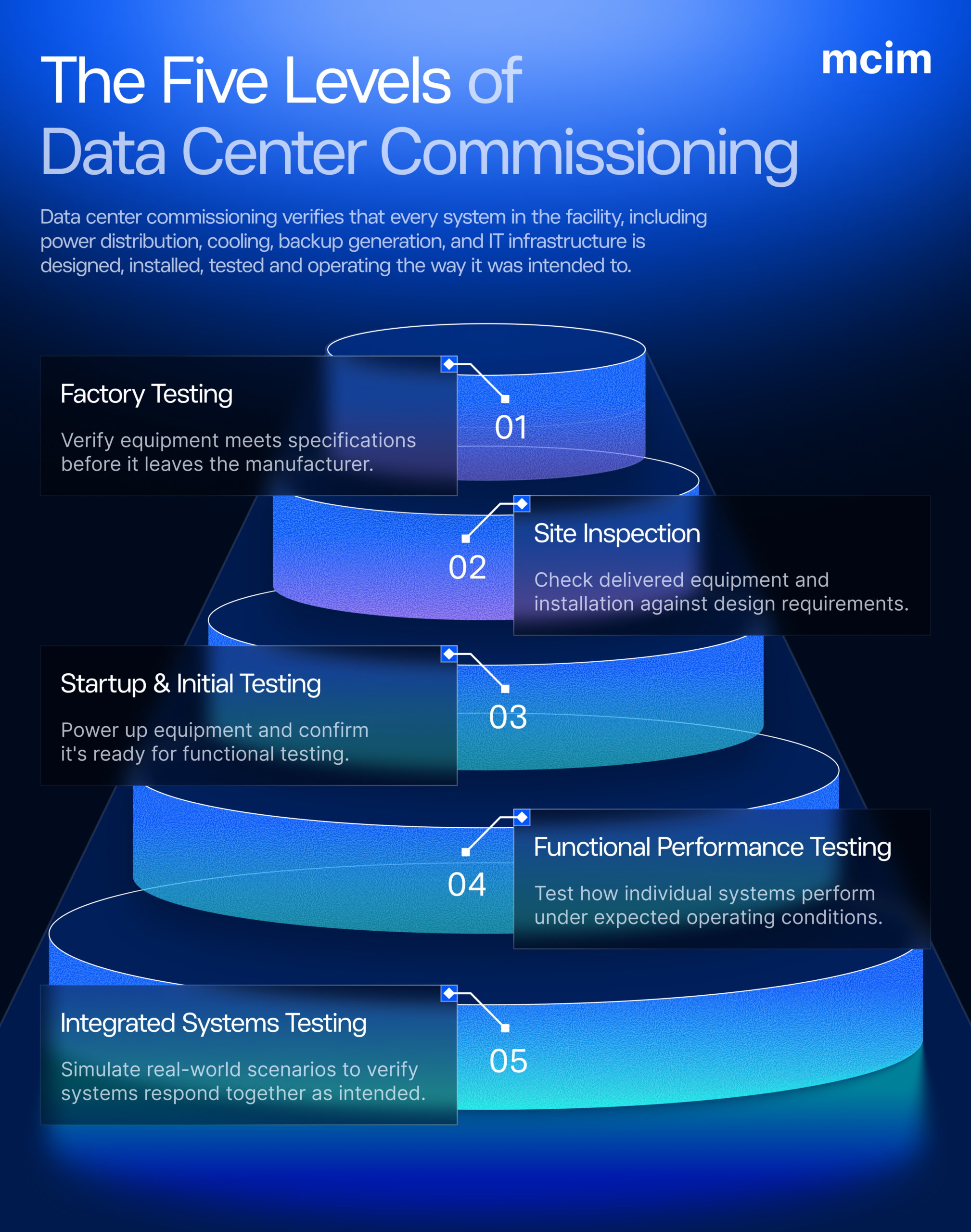
By the time integrated systems testing is complete, an operator can have a rich body of information about the environment, including:
- Asset and configuration baseline: What was actually installed, where it is located, how it is configured, and how assets relate to one another.
- Known good performance baseline: How equipment and systems perform when healthy, including power, temperature, pressure, flow, vibration, efficiency, and other critical parameters.
- Operating parameters and controls: Validated setpoints, run-time schedules, thresholds, sequences, SLAs, alarms, interlocks, and control logic.
- Failure and recovery behavior: How systems actually respond, fail over, stabilize, and recover during abnormal conditions and integrated systems testing.
- System dependencies: How electrical, mechanical, and control systems interact and what equipment or capacity may be affected by a failure.
- Operational playbook: Maintenance requirements, SOPs, MOPs, EOPs, critical spares, commissioning deficiencies, and corrective actions.
Commissioning may also reveal characteristics that never appear on a manufacturer’s specification sheet: how an asset behaves under a particular load, adjustments required during testing, compatibility issues with connected equipment, or even an early component failure.
Months or years later, those observations can inform a technician investigating an abnormal condition, an engineer analyzing reliability, or a capital planning team deciding whether an asset should be repaired, overhauled, or replaced.
Better Decisions Begin With What You Already Know
By the time a facility reaches RFS, that record could already contain information operators need to understand what they’ve inherited: the asset and configuration baseline, commissioning results, procedures, dependencies, known good performance, deficiencies, and corrective actions. Bring that information together, and day one becomes a continuation of the facility’s history rather than the point at which the organization has to start trying to assemble it.
That continuity gives operators a more complete basis for decisions. They can compare current conditions not only with yesterday’s telemetry, but with the original known good state of the asset and system, the work performed since commissioning, and the outcomes of prior interventions.
Consider a technician investigating an unusual chiller condition several years after commissioning. Knowing the current temperature, pressure, or vibration reading is useful. Knowing how that same asset performed during commissioning, whether the condition has appeared before, what maintenance followed, and whether that intervention improved performance provides significantly more context. That’s the value of continuity.
New Infrastructure Makes Your Own History More Valuable
This becomes even more important with AI and HPC infrastructure. Operators are deploying higher-density equipment, new cooling architectures, and complex assets with less accumulated operating history to draw from.
Even without operating history, new facilities can draw on established standards and benchmark data from similar equipment and environments. As these assets accumulate data sets post deployment, that information becomes increasingly valuable when combined with evidence of how they perform. That dataset, with site-specificity, develops throughout the infrastructure lifecycle, with each stage contributing something different:
- Commissioning establishes the initial performance baseline.
- Maintenance demonstrates how equipment responds to intervention.
- Incidents expose failure modes and corrective actions.
- Telemetry shows how performance changes over time.
Preserve those records together and an organization begins creating its own body of evidence about how its infrastructure behaves in the real world. With a consistent operational data model in MCIM, lessons from similar equipment, maintenance activities, and incidents can begin informing reliability decisions across an entire portfolio.
The Digital Thread Is the Foundation for AI
The same continuity becomes critical as operators move toward condition-based maintenance, predictive operations, and AI-assisted decision making. After all, AI is only as useful as the context available to it. Telemetry can tell you that something has changed, but a complete operational history can help explain what changed, whether it matters, what happened under similar conditions before, and what action produced the best result.
This is the foundation MCIM is building for Merin: MCIM provides the operational context including assets, procedures, maintenance history, incidents, risks, assessments, and the relationships among them. Merin can use that context alongside performance data to help operators identify meaningful changes, understand what has happened before, and make better informed reliability decisions.
For example, rather than servicing a condenser solely because a calendar says maintenance is due, an operator could use actual operating performance and asset history to determine when intervention is warranted. Post-maintenance telemetry could then show whether the work restored performance toward its commissioning baseline.
Each intervention creates another data point. Each data point enriches the asset history. And each asset history improves the organization’s ability to make the next decision. That’s where a consistent digital twin and digital thread become much more than documentation. With MCIM as the operational system of record, they can become an intelligence layer connecting what the organization designed, built, tested, learned, maintained, and operated.
Ready for service shouldn’t be the beginning of a data center’s history. It should be the next chapter, with everything the facility has already taught you coming along with it.