Triple nines and SLA response times used to be the benchmark for operational excellence, but that standard has changed. Sophisticated tenants and investors are now asking a different question, and in this blog, MCIM CEO Mike Parks discusses why reliability analytics is how you answer it.
Operational maturity is easy to measure when things are going wrong. The harder question (and the more important one) is whether you can measure it when things appear to be going right. That’s what reliability analytics is designed to answer, and it’s why it’s become the category that separates organizations that are genuinely ahead from the ones that are managing well enough until something breaks.
When I evaluate operational maturity with customers, I’m looking across eight capabilities that together form the complete picture of how well an organization’s operations are functioning.
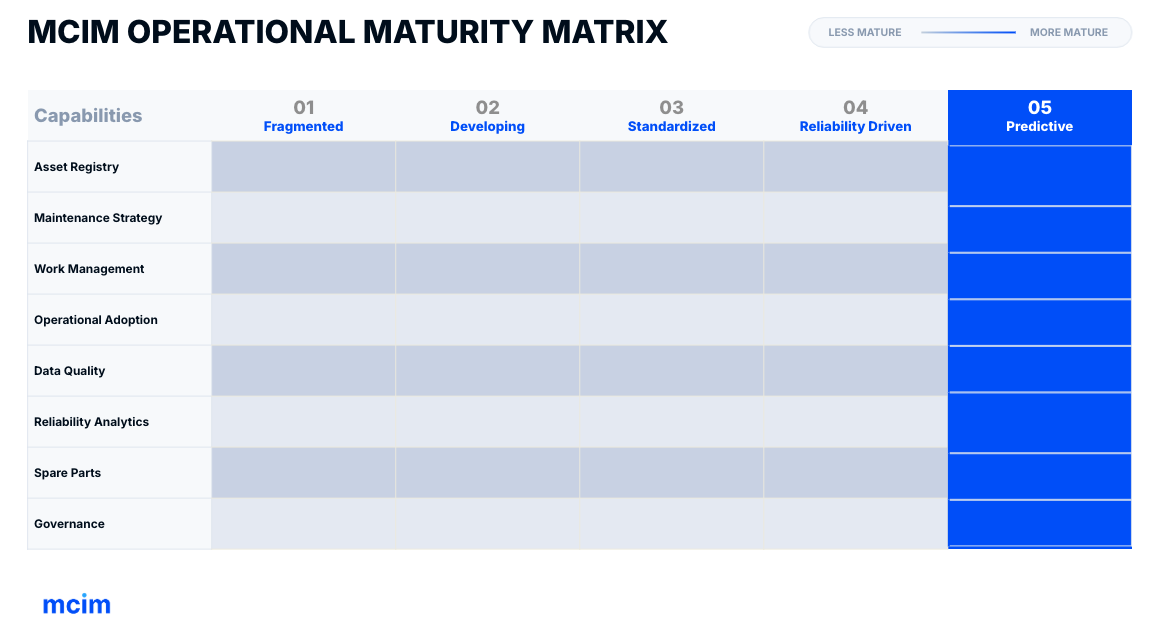
Each one matters and each one builds on the others. But reliability analytics is different, because without it, you won’t know if everything else is actually working:
- You can have a documented maintenance program and still not know whether it’s reducing risk.
- You can have dashboards and still not know whether the data they’re displaying is accurate enough to act on.
- You can have incident records and still not know whether the patterns in those records are telling you something important about what’s coming next.
Reliability analytics is the capability that connects execution to outcomes, and in many organizations, that connection is missing.
What Reliability Analytics Actually Requires
The effort organizations put into maintenance programs is real, and the commitment behind it is genuine. The gap that shows up consistently is in whether the systems capturing that work are connected well enough to tell you if it made a difference. Most organizations can produce a maintenance history, but fewer can tell you whether that history is driving mean time between failure down, reducing risk exposure, or improving asset performance over time. The commitment is there, but the connection isn’t, and it’s a challenge that shows up across organizations of every size and maturity level.
Reliability analytics requires that your asset data, maintenance records, incident history, and your operational execution are all structured well enough, and connected closely enough, to produce meaningful insight. When any one of those layers is fragmented or unreliable, the analytics built on top of it can’t be trusted, and decisions made from that analysis carry hidden risk.
The organizations that have mature reliability analytics can answer questions that most operators can’t:
- Which OEM models are performing most reliably in their specific environment?
- Where are they over-maintaining or under-maintaining?
- Which vendors and technicians are creating the most risk?
- Where is degradation building in the portfolio right now, before it becomes a failure event?
One enterprise customer saw this play out directly. During a new generator installation, connected tracking in MCIM surfaced a systemic failure pattern that wouldn’t have been visible looking at any single unit in isolation. It was a pattern serious enough that the customer secured millions of dollars in manufacturer-paid repairs as a result. That’s the difference reliability analytics makes: not just knowing something failed, but knowing it as part of a pattern early enough to act on it, and with enough evidence to hold the right party accountable.
Where the Industry’s Heading
I want to be direct about something that’s changing in this space. For a long time, the benchmark for operational excellence was reliability as a historical metric: triple nines, SLA response times, and past uptime performance. Those numbers still matter, but they’re becoming table stakes.
The question sophisticated tenants and investors are increasingly asking is forward-looking: where’s risk building in your environment right now, and what are you doing to get ahead of it? That’s a fundamentally different question, and it requires a fundamentally different operational capability to answer.
The maintenance leader of the future isn’t going to log into a dashboard, parse the data, and figure out what to go do. That model is already outdated. The future is push intelligence: the right context, surfaced at the right moment, so that the person making the decision can apply their judgment to a situation they already have the information they need to address. When human beings fail operationally, it’s almost always because they were asked to make a decision under pressure without the context or experience to make it wisely. The answer to that won’t be accomplished with more dashboards, but with better intelligence delivery.
Hyperscalers are already operating this way: roughly 12 to 24 months ahead of most colocation and enterprise operators in terms of where the market is heading. They’ve made the transition from incident response to incident prevention. They’ve consolidated ticketing systems. They’ve built operational models where the data, the context, and the execution are all connected.
The operators who prioritize reliability analytics now are building the kind of operational intelligence that gets harder to replicate the longer you wait to start.