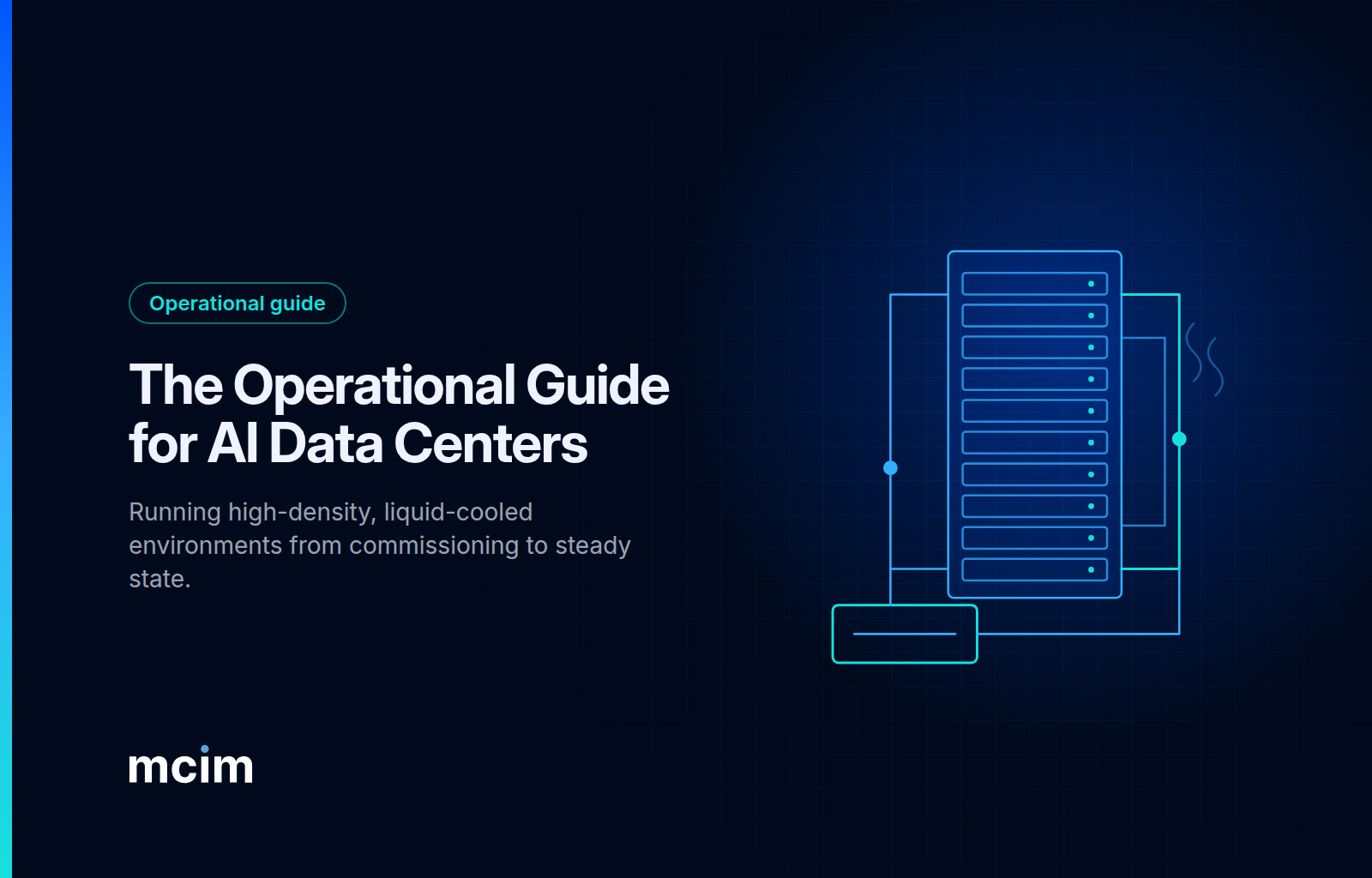
AI has changed the physics of the data center. NVIDIA H100 and H200 GPUs dissipate up to 700W each, and Blackwell chips go past 1,000W. A single rack can represent millions in capital, and thermal instability degrades performance before anyone notices. Cooling is no longer a facility enhancement. It is a compute dependency.
Most outages in liquid-cooled environments don’t start with hardware. They start with visibility gaps, siloed IT and Facilities teams, and processes built for air-cooled rooms. The Operational Guide for AI Data Centers lays out the operating model that closes those gaps, from site assessment through commissioning, daily operations, and sustainability reporting.
Key figures from the guide
- 700W+ heat output per GPU in current AI racks
- 1.03 PUE achievable with disciplined liquid-cooled operations
- 40% cooling energy savings compared to air
What’s inside
- Site assessment and readiness: what to evaluate before liquid cooling goes in.
- Commissioning: acceptance testing and handoff practices for high-density deployments.
- Steady-state operations: water quality management, preventive maintenance, and the KPIs to track.
- Risk management: treating fluid management with the same rigor as power distribution.
- IT and Facilities coordination: keeping minor thermal events from turning into outages.
- Sustainability reporting: measuring and reporting PUE and WUE performance.
“By 2027, more than 60% of new enterprise-class AI infrastructure deployments will require some form of direct liquid cooling.”
Mike Parks, CEO, MCIM