Stage 1 is the foundation of the MCIM Operational Maturity Matrix, and where many data center operations remain, despite years of investment in tools and systems. MCIM CEO Mike Parks explains why getting beyond it starts with an honest look at the outcomes those investments are actually producing.
When I sit down with operators across our customer base and the broader industry, I hear consistent themes: years of genuine investment in tooling, real commitment to building maintenance programs, and dashboards that took significant effort to stand up. The intent is always there, and the people running these operations are talented, experienced professionals who care deeply about doing things right.
What I’ve come to understand, though, is that the industry has been optimizing against the wrong baseline. We’ve been measuring operational maturity by the presence of systems and processes rather than by the outcomes those systems and processes are producing. And when you shift the question from “do you have the right tools?” to “are those tools producing the results you need them to?” two specific questions tend to surface the gap:
The first: are you 90% confident that your asset repository accurately reflects what’s actually out in the field: the make, model, serial number, installation date, expected useful life, and cost of the critical equipment you depend on?
The second: do you have documented maintenance standards for all of that equipment, and are they being executed consistently across every site, every shift, and every team?
These aren’t trick questions, and they’re not meant as a criticism of the work that’s been done. They’re the foundational questions that everything else in critical facility management is built on, and across the countless in-person conversations with operators since I joined MCIM, they’re the questions that most consistently reveal any gaps between where organizations believe they are and where the data says they actually are.
Most will say they’re probably halfway there on the asset side. On maintenance execution consistency, the answer is harder to give, because many organizations don’t yet have the KPIs in place to know. It’s definitely not a failure of effort, it’s a reflection of how the industry has historically defined success. And it’s exactly what the MCIM Operational Maturity Matrix is designed to help operators see clearly and address systematically.
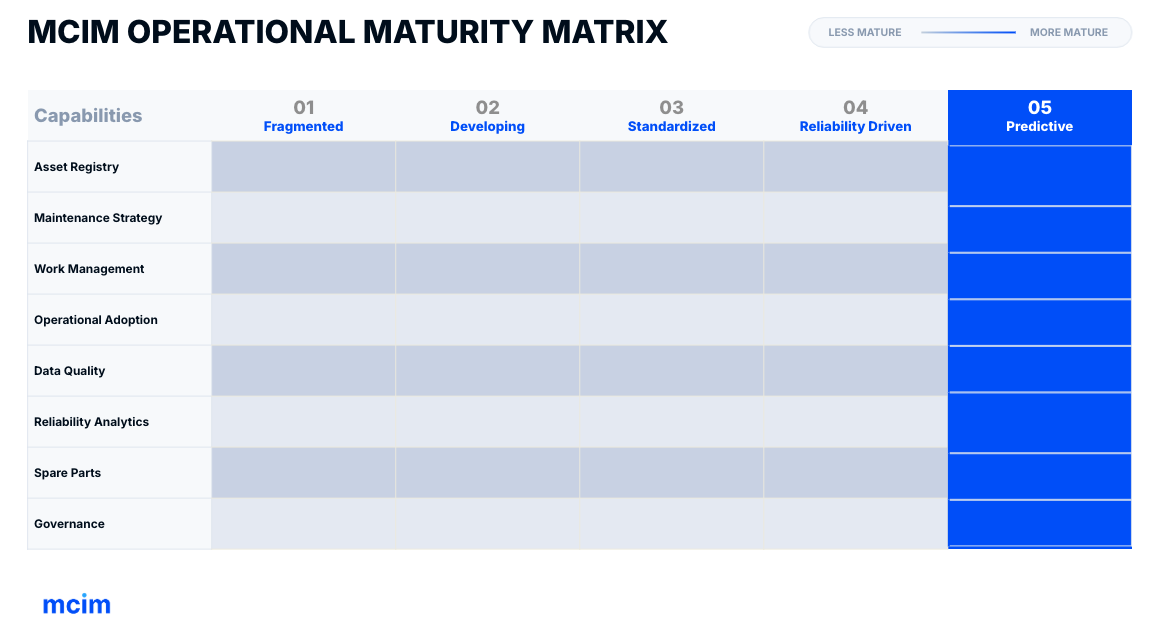
As I referenced in Navigating the Five Stages of Data Center Operational Maturity, the MCIM Operational Maturity Matrix maps how organizations progress from fragmented, reactive operations toward standardized, measurable, and ultimately predictive operating models. Each stage builds on the one before it, which is why organizations can’t skip over the fundamentals. Stage 1 isn’t simply the beginning of the journey, it’s how organizations build the foundation every higher level can depend on.
What Stage 1 Actually Looks Like
Stage 1 isn’t obvious from the outside, which is what makes it so common and so risky. Processes exist and tools are running, but when I look at the data from audits we’ve done with operators, I consistently find the same pattern: elements of genuine operational excellence surrounded by disparity elsewhere. The facility in the next city, the next country, the next time zone is operating by different standards, tracking different data, and producing different outcomes, all inside the same company. And critically, leadership often may not consider themselves to be “at Stage 1” without the matrix in front of them, because they don’t have the data infrastructure to see it.
I had this conversation recently with a customer who has been running data centers for more than two decades, using the same operational tooling with the same partner for five consecutive years. When I walked them through the MCIM Operational Maturity Matrix and asked them to self-assess, they ended up rating themselves at Stage 1 across five or six of the eight categories. That’s what makes Stage 1 so difficult to recognize. The gaps rarely reveal themselves until organizations stop asking whether they have the right tools and start measuring whether those tools are producing consistent operational outcomes.
The Foundation That Everything Else Depends On
I’ve spent enough time in this industry to know you can simplify almost any operational challenge down to its essence. For critical facility management, the essence is this: do you have an asset database you trust? If the answer is no, nothing else matters, because you won’t be able to:
- deploy a meaningful maintenance program against equipment you can’t accurately describe.
- make defensible capital decisions about assets you don’t have reliable data on.
- answer a tenant or investor question about infrastructure risk when the virtual representation of your portfolio doesn’t match what’s actually in the field.
The data points that matter for any critical asset aren’t complicated, but if those fields aren’t populated accurately, you can’t answer the most basic operational question: do I repair this, or do I replace it?
At the portfolio scale most operators are managing today, the cost of guessing is a line item: get a repair-or-replace call wrong on a single chiller and you’re either stranding six figures of remaining useful life, or running an asset to failure and absorbing the downtime event behind it.
Here’s where most organizations get tripped up: they treat asset accuracy as a project rather than a discipline. An audit gets commissioned and when the data comes back, for a brief window, the repository reflects reality. And then equipment keeps getting replaced daily, with no clear process for updating the record. Who retires the old asset? Who inserts the new one? Without a standard operating procedure for maintaining accuracy, every audit becomes a point-in-time snapshot that begins degrading the moment it’s taken.
The solution requires making it somebody’s job:
- Assign ownership
- Build a RACI
- Create an SOP for what happens when equipment is repaired or replaced.
And then accept that directionally correct is better than scientifically precise. If you’re not certain of every installation date, plug in the facility opening date as a baseline. It’s better than a blank field.
Why Maintenance Standards Can’t Come Second
Once the asset foundation is in place, the next question is whether you have documented maintenance standards and whether they’re being executed consistently. These aren’t the same as whether maintenance is being performed.
With every planned preventive maintenance event, someone’s job needs to be “inspect what you expect.” That means not just verifying that fourteen boxes were checked, but confirming the work was done to the standard it was supposed to be done to. I use a simple analogy: imagine ordering from a fast food restaurant and receiving a bag with a receipt showing every item checked off. That doesn’t mean what’s in the bag is what you ordered. Someone has to actually look inside.
Maintenance standards themselves aren’t hard to find: OEM manufacturers, ASHRAE, SFG20, and other standards bodies will tell you exactly how equipment should be maintained. The work is in digitizing those standards, loading them into your operational system, and verifying that execution is consistent across every site, not just the ones where a strong site leader is driving it.
The Mindset Shift That Moves You Forward
Organizations stuck at Stage 1 are typically spending most of their time on incident response: reacting to what broke, writing root cause analyses, and managing the fallout. The organizations moving beyond Stage 1 are spending more time on incident prevention by understanding where risk is building before it becomes an outage. Hyperscalers are largely already there, and that standard will increasingly be demanded of everyone else.
The fundamental mindset change begins with the end in mind: knowing what you’re trying to accomplish and how you’ll measure whether you’re on track. At Stage 1, the KPI is simple: what percentage of critical assets are captured, and do I have 100% of the required fields populated? Until that’s true, everything built on top of it is built on uncertainty. Get the foundation right, and everything else becomes possible.
The first step toward moving through the MCIM Operational Maturity Matrix is knowing where you stand. Head here to learn how MCIM Operational Audits can give you a foundation for continuous improvement.